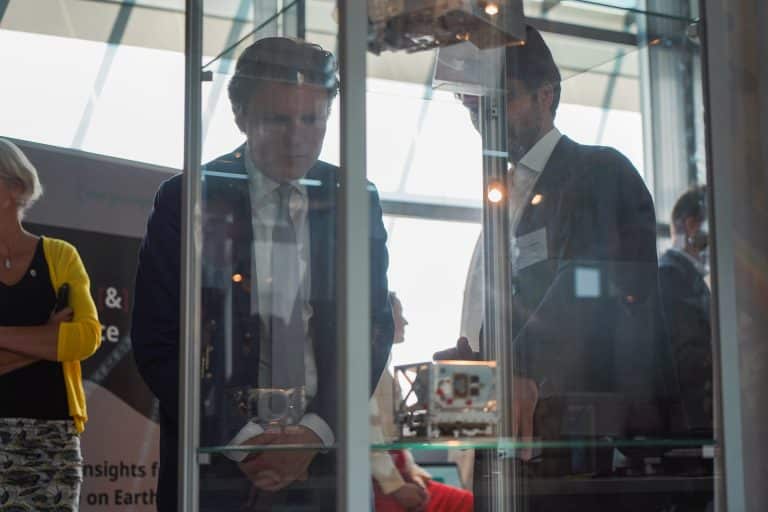
On June 12, 2025, cosine proudly hosted a high-profile visit to its Sassenheim facilities and unveiled to the Dutch Minister of Defence, Ruben Brekelmans, and State Secretary, Gijs Tuinman, the new microsatellite-class instrument lines ValkTM and TScout® HP, primary sensors behind the PAMI-1 satellite project. The visit marked an important milestone for the Dutch space and defence sectors, highlighting the crucial role of national innovation in strengthening autonomous safety and resilience capabilities.
Contracted by the Dutch Ministry of Defence for this program, cosine is developing Valk, a Very High Resolution (VHR) Earth observation (EO) electro-optical instrument, the first demonstrator of which will be used on PAMI-1 to gather visible and spectral data for the Intelligence, Surveillance and Reconnaissance (ISR) units of the Dutch Defence. Additionally, a secondary payload, TScout HP, will be integrated to provide high resolution thermal imaging capability, demonstrating thermal imaging use cases to further enhance the ISR process. This will be particularly useful in low-visibility conditions such as at night, or when obscured by smoke, fog, or dust, as it detects heat signatures rather than relying on visible light.
As the primary sensor provider for the PAMI-1 satellite, cosine welcomed the opportunity to show its advanced measurement solutions and to facilitate knowledge exchange between government leaders, high-tech companies, and research institutions. During the event, participating companies presented their technological contributions to the PAMI-1 mission, which represents a new chapter in Dutch sovereign military space capabilities.
Enhancing Dutch space capabilities
Expected to launch in early 2028, PAMI-1 is the first in a foreseen series of satellites designed by the Dutch Space Industry to build as new national space capabilities for the use by the Dutch Ministry of Defence. Equipped with state-of-the-art sensors and communication technologies, including laser communication, PAMI-1 will play a pivotal role in modern defence EO needs..
Minister Brekelmans highlighted the wealth of expertise present within the Netherlands, with many companies and institutions leading the way in the space defence sector: “These companies also see that rapid innovation is necessary in light of increasing threats. The space domain is becoming increasingly important in modern defence and warfare. The Netherlands possesses unique knowledge in this area.”
State Secretary Tuinman echoed this, stating: “We want the Netherlands to have a sovereign position in space as well. The Dutch PAMI-1 satellite will be equipped with laser communication, which is a huge leap forward compared to traditional radio connections. In the coming years, we will build dozens of our own satellites, allowing us to collect information and imagery independently.”
Collaboration drives innovation
The visit also showcased how close cooperation between industry, government, and research institutes can lead to meaningful advances in space technology.
“We are honoured to play a central role in a project that will advance Dutch innovation,” said Dr Marco Esposito, Managing Director of cosine Remote Sensing. “For cosine, this also opens the door to developing innovative solutions for larger satellites, allowing us to push the boundaries of Earth observation and satellite imaging technology even further. It strengthens our capabilities and elevates us to a higher class of instrumentation, well-positioned for primary optical payloads across commercial, institutional, security and resilience, as well as ESA programmes.”
With PAMI-1 and future missions on the horizon, cosine remains committed to advancing space instrumentation for the benefit of society.
About cosine
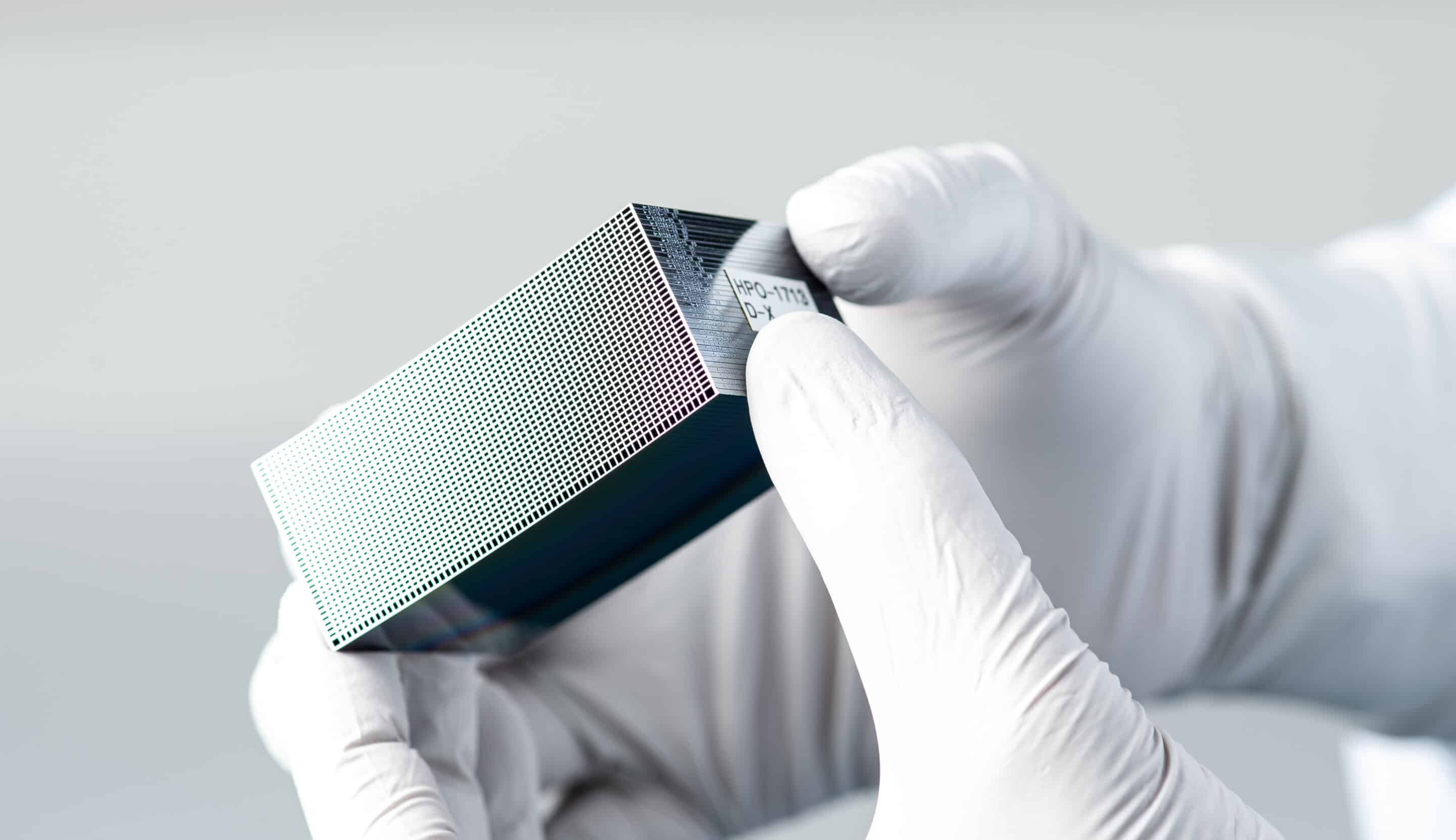
cosine is a leading worldwide company in the development of space instrumentation, such as Silicon Pore Optics for astronomy and remote sensing solutions with onboard analytics for Earth Observation and planetary science. cosine combines physics and technology to bring out-of-the-box solutions to its clients. cosine has been developing and delivering innovative measurement systems for space and industrial applications since 1998. The company operates more than 1,000 m2 of cleanrooms and high-tech assembly facilities to build and test the systems we produce for customers at our headquarters in Sassenheim, The Netherlands and at subsidiaries in Berlin, Germany and Benevento, Italy.
About the Defence Space Security Centre of the Ministry of Defence
The Defence Space Security Centre (DSSC) as part of the Dutch Ministry of Defence focusses on the military space domain for the benefit of the entire armed forces and other government departments to ensure knowledge building and the development of operational space capabilities as per NATO’s six functional areas.